
Play Integrity and GrapheneOS: why some apps refuse it
A few months ago, I bought a Google Pixel. The poor thing hadn’t even finished booting before I had unlocked its bootloader and installed my favorite OS of the moment, GrapheneOS . So, a Google phone, but without Google on it (or almost).
For a while, everything was fine. I paid with my bank’s app over NFC , just like everyone else. Then some apps started refusing to work, with no explanation other than a message saying my device was “not compatible,” “not secure,” or even that it was a rooted phone . Which it obviously isn’t.
The culprit is called Google Play Integrity API .
I’ve never hidden my dislike of DRM , and this API bothers me in the same way. The more I look into how it works, the more I see it as part of a worrying trend: Android is still officially open, but Google controls an ever-growing share of it.
How does Google Play Integrity work?
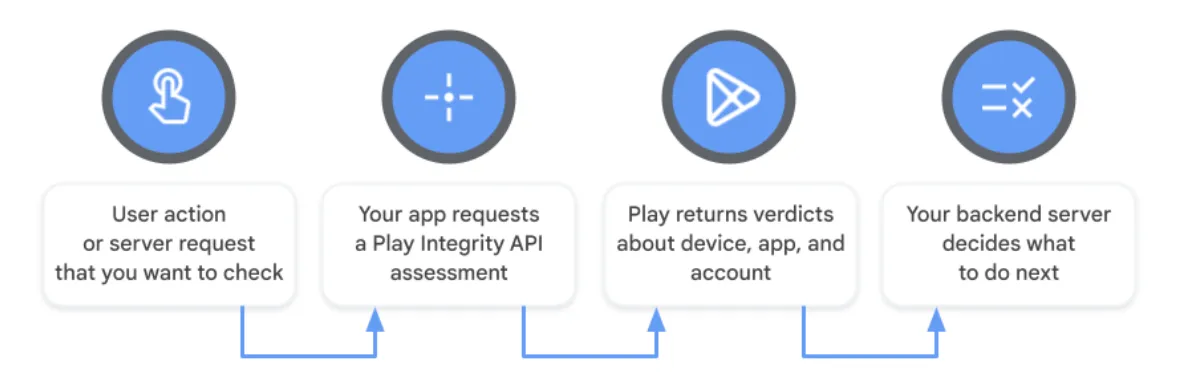
The Play Integrity API replaced SafetyNet (the transition was completed in May 2025). When a sensitive action takes place, the app requests a verdict from Google Play Services. Google then evaluates the app (is this really the unmodified binary recognized by the Play Store?), the account (did the app come from the Play Store?) and the device. It returns a signed token, which the app’s server verifies. It’s then up to the developer to decide whether to grant access, restrict certain features or block everything.
The decision belongs to the developer, but Google is the judge.
For the device, there are three integrity levels:
| Level | What it means | Typical example |
|---|---|---|
MEETS_BASIC_INTEGRITY | Basic integrity checks. The bootloader can be locked or unlocked, and the device may not be certified by Google. On Android 13 and later, however, the attestation’s root of trust must be provided by Google. On its own, this level does not guarantee the device’s security or privacy. | A device running an alternative OS, such as GrapheneOS |
MEETS_DEVICE_INTEGRITY | Genuine, certified Android device. On Android 13 and later, hardware-backed proof that the bootloader is locked and that the OS is a certified manufacturer image. | A certified Pixel, Samsung or Xiaomi running its stock OS with a locked bootloader |
MEETS_STRONG_INTEGRITY | Same as the previous level, plus, on Android 13 and later, security updates less than a year old on all relevant partitions. | A recent Pixel running official Android with up-to-date patches |
By default, the API returns the MEETS_DEVICE_INTEGRITY verdict. The “basic” and “strong” levels are optional additional labels that developers can enable in the Play Console. On Android 13 and later, they are also only returned if the app is licensed through Google Play.
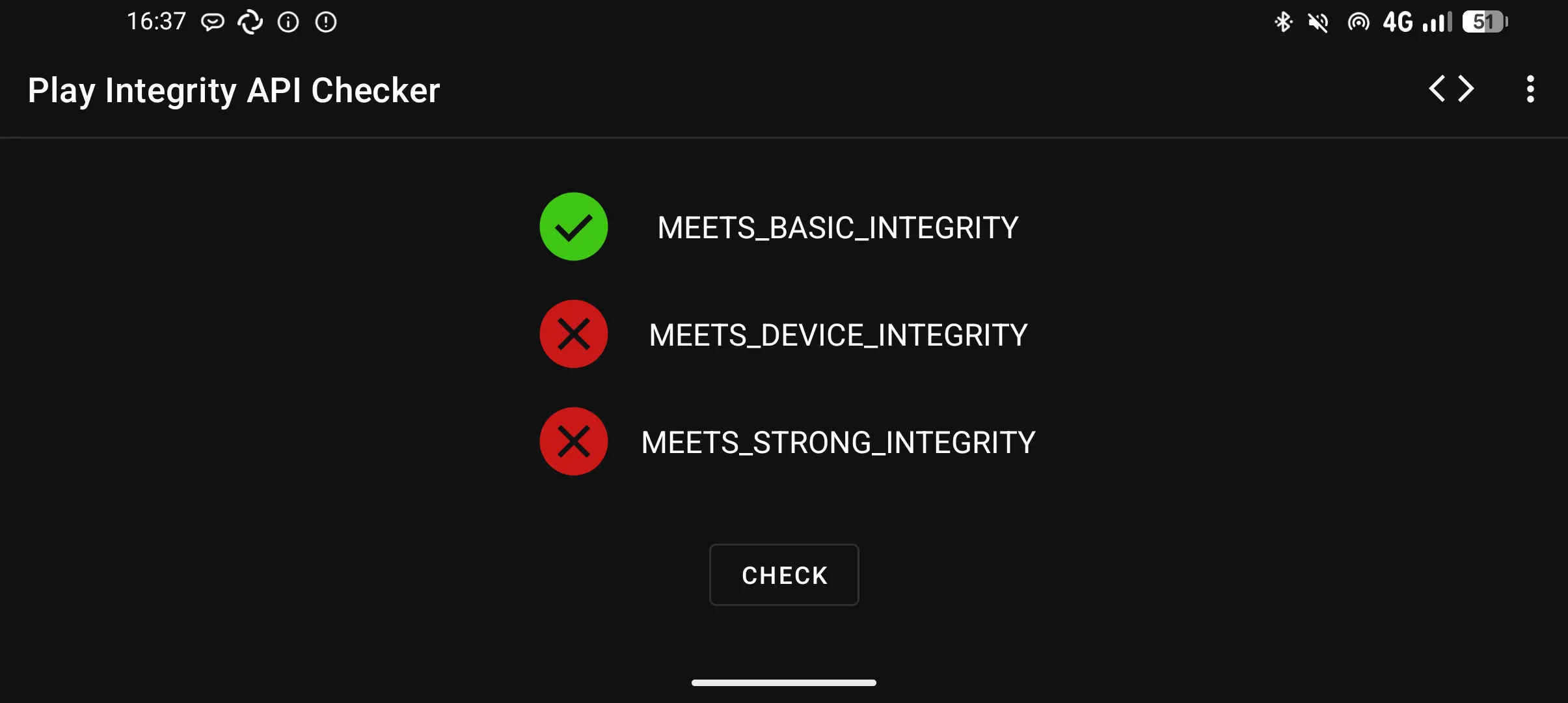
See the verdict received (JSON excerpt)
Actual verdict returned on GrapheneOS: the app and the account are validated, Play Protect reports no issues, and only the “device” level is missing. The sdkVersion 37 corresponds to Android 17, so an up-to-date system.
{
  "appIntegrity": { "appRecognitionVerdict": "PLAY_RECOGNIZED" },
  "deviceIntegrity": {
    "deviceRecognitionVerdict": ["MEETS_BASIC_INTEGRITY"],
    "deviceAttributes": { "sdkVersion": 37 }
},
  "accountDetails": { "appLicensingVerdict": "LICENSED" },
  "environmentDetails": { "playProtectVerdict": "NO_ISSUES" }
}
In my test, GrapheneOS gets the basic level. And yet it keeps Verified Boot, with a relocked bootloader and its own signing key. So the problem isn’t a lack of security mechanisms: GrapheneOS simply isn’t certified by Google.
And since the basic level is optional, an app that doesn’t request it won’t receive this extra label. The MEETS_DEVICE_INTEGRITY verdict remains the one returned by default.
The project has made it clear that it won’t try to fake this certification. As for the “strong” level, it relies on the hardware guarantees of the “device” level, with an added requirement for recent security patches. Google could also block any attempt to bypass it. Above all, cheating would undermine the project’s argument that this API is anticompetitive.
What Google Play Integrity really protects
Banks have payment security obligations. Google also highlights how effective its system is: according to a post published on its Android Developers blog in November 2025, apps using Play Integrity API features see on average 80% less unauthorized usage than other apps. An impressive figure, but one reported by Google itself, without any detailed methodology in that post to independently assess what it really means.
Still, it’s fair to ask whether this system actually checks a device’s security, or mostly checks that the device suits Google.
A device can meet the “device” level without necessarily having the latest security patches. On Android 13 and later, it’s precisely the “strong” level that adds a patch-freshness requirement across all relevant partitions.
Google emphasizes hardware signals that are highly resistant to bypasses. GrapheneOS offers a more nuanced view: hardware attestation itself can be robust, but the way Play Integrity uses it is less so, because it trusts any chain leading back to a known root. The secure approach is rather to pin the expected keys.
That’s exactly what the standard hardware key attestation API, available in Android for years, makes possible. A server can verify information about the hardware, the OS and the app’s identity, notably based on the Verified Boot key, without going through Google’s servers. The GrapheneOS project publishes an attestation compatibility guide explaining how to do it: verify the attestation chain and accept the project’s official keys in addition to stock devices.
According to community reports, about a dozen banking apps now accept GrapheneOS, some of them thanks to this method.
Not everyone agrees, though. In the case of a Dutch bank, a letter attributed to EPI (the entity behind Wero) argues that hardware attestation alone doesn’t provide the guarantees its fraud detection models require. The two sides disagree on what the API can actually verify. anoni.net’s analysis looks back at this exchange.
But even if banks’ needs are legitimate, that doesn’t explain why a verified, up-to-date system is rejected by default.
UnifiedAttestation: a European alternative in the works
In March 2026, a European consortium led by Germany’s Volla Systeme, including Murena (/e/OS), iodé and Apostrophy, announced UnifiedAttestation, an open source alternative to Play Integrity for AOSP-based systems without Google services. The UBports Foundation has also expressed interest in the initiative.
The project, licensed under Apache 2.0, is built on three components: a system service that can be integrated into Android, a backend that verifies attestations and issues signed tokens, and an open test suite for evaluating an operating system on a given device model. App servers can then verify these tokens offline. The project also plans a federation mechanism between multiple parties, so as not to depend on a single authority.
The consortium wants this cooperation to take place within an open framework, under the umbrella of the Eclipse Foundation. Developers of Scandinavian public-sector apps are among the first interested in testing it.
The stakes go beyond banks: at the time of the announcement, the European Digital Identity Wallet (EUDI Wallet) app relied on Play Integrity, which effectively excluded alternative Android systems. Developers flagged this on GitHub, comparing the situation to a PC that would require Windows to open an official document.
The project is still young, and convincing banks to adopt a system they don’t know yet will be the biggest hurdle. GrapheneOS, incidentally, isn’t among the members mentioned in the press.

An open project, increasingly closed control
Android Inc., founded in 2003, was acquired by Google in 2005. In 2007, Google announced the Open Handset Alliance , promising an open mobile platform. The first phones came out in 2008, along with the release of the source code. This project is known as the Android Open Source Project (AOSP), based on the Linux kernel and released under the Apache 2.0 license .
It’s thanks to this openness that projects like GrapheneOS or LineageOS can exist.
Mind you, open doesn’t mean independent from Google. Around AOSP, the company has built a whole proprietary layer: Play Store, Play Services, Chrome, Maps and certification. Technically, a manufacturer can ship AOSP without Google services. In practice, selling a phone without the Play Store is far more complicated, and to get Google’s apps, manufacturers must notably accept contracts imposed by the company.
The European Commission took a close look at these practices. Some agreements tied the Play Store license to the preinstallation of Google Search and Chrome, while anti-fragmentation agreements prevented manufacturers who wanted Google’s apps from selling devices running modified versions of Android.
Following these investigations, a €4.34 billion fine was imposed in 2018, reduced to €4.125 billion in 2022, and then definitively upheld by the Court of Justice of the EU on July 2, 2026. Google says it has changed its agreements since 2018.
To me, the fact that a manufacturer needs the approval of an American company to sell a viable Android phone is already a problem in itself. And it’s not the only issue:
- The code is becoming scarcer: since 2026, AOSP code is only released twice a year, compared to four times before. According to the tech press, development now happens more internally. Google insists AOSP isn’t going away and cites platform stability.
- Developers must identify themselves: since September 30, 2026, apps must be registered by a verified developer to be installed through participating stores on certified devices in Brazil, Indonesia, Singapore and Thailand. A global rollout is planned for 2027. Google does, however, keep an advanced flow allowing experienced users to install unregistered apps, as well as installation via ADB.
- Devices must be approved: that’s precisely the role of the Play Integrity API.
My position
No company should be able to control, end to end, the devices in circulation.
Today, Google and Apple share almost the entire mobile market, and each controls certified hardware, the operating system, the app store and the rules for accessing apps. I think we should:
- Prohibit making the license for essential services conditional on exclusivity.
- Separate the operating system, the app store and integrity attestation.
- Require interoperable attestation mechanisms that can accept multiple roots of trust, as UnifiedAttestation proposes.
- Guarantee owners the right to install the OS of their choice without automatically losing access to their bank.
Of course, Google and Apple argue that strong control protects users against malware and fraud, with a smaller attack surface, fewer scams and clear accountability for publishers when something goes wrong. Google also defended its agreements by pointing to the risk of Android fragmentation. European courts rejected that argument in this case, but the problem isn’t imaginary either. So one could argue for a more gradual approach, based on targeted interoperability obligations rather than a blanket ban.
But in my view, two issues shouldn’t be confused. Security is a technical problem that can be addressed with technical solutions, notably open standards. Market control is a political problem that requires rules.
Writing to the publisher: how to go about it
Complaining costs nothing, but it doesn’t change much either. A polite, somewhat technical message has a much better chance of getting results. The GrapheneOS project actually reports that several apps ended up accepting the OS after user requests. Nothing is guaranteed, but it’s worth a try.
Here’s a message template you can adapt:
Subject: [name] app unusable on GrapheneOS: request to update the integrity check
Hello,
I am a customer of [service name] and I used the [name] app on a Google Pixel running GrapheneOS. Since [date / version], it displays the following message: “[exact message]”.
GrapheneOS keeps Verified Boot, with a relocked bootloader and the project’s own signing key. It also receives regular security updates. However, it is not certified by Google and therefore does not meet the
MEETS_DEVICE_INTEGRITYverdict.I am not asking you to lower the security level. Instead, I suggest using Android’s standard hardware attestation API, which makes it possible to verify information about the hardware, the OS and the app without depending on Google services, and allowing GrapheneOS’s official Verified Boot keys. The Play Integrity API could remain a fallback for other devices.
The project’s guide details the method: https://grapheneos.org/articles/attestation-compatibility-guide
Could you forward this request to your technical team and let me know which integrity level the app currently requires?
Best regards, [Name]
Conclusion
Just a few months ago, I could pay with my bank’s app on my Pixel running GrapheneOS. Today, some apps shut me out even though my system is up to date, its boot chain is verified and my apps are sandboxed.
I don’t really see what this blocking gives me in terms of security. On the other hand, I know very well what it takes away: the freedom to use my phone as I see fit.
To me, it’s just not worth it.
Sources
- Integrity verdicts (Android documentation).
- Detect risky interactions and fight abuse with the Play Integrity API (Play Console Help).
- Stronger threat detection, simpler integration: Protect your growth with the Play Integrity API (Android Developers, November 19, 2025).
- Making the Play Integrity API faster, more resilient, and more private (Android Developers Blog).
- Attestation compatibility guide (GrapheneOS).
- “Play Integrity MEETS_DEVICE_INTEGRITY” thread (GrapheneOS forum).
- Wero payments and Play Integrity checks in the Dutch ASN Bank app (anoni.net).
- Paying without Google: New consortium wants to remove custom ROM hurdles (heise).
- A European consortium launches an open source alternative to Google Play Integrity (Korben).
- Google Android, the Final Chapter (Skadden, July 2026).
- Google will now only release Android source code twice a year (Android Authority).
- Android developer verification (Android documentation).
FAQ
Does GrapheneOS pass the Play Integrity API?
In the case tested, GrapheneOS gets the basic level (MEETS_BASIC_INTEGRITY). This additional verdict must be explicitly requested by the developer and, on Android 13 and later, the app must also be licensed through Google Play. GrapheneOS doesn’t meet the “device” level and therefore can’t get the “strong” level, which depends on it.
Is GrapheneOS less secure than official Android?
Not necessarily. It keeps Verified Boot, with a locked bootloader and its own signing key. It doesn’t need to be rooted. Its failure to meet the “device” level comes from the lack of Google certification, not, in itself, from a security flaw.
What is the alternative to the Play Integrity API?
The hardware key attestation provided by Android. By verifying the attestation chain and accepting several trusted Verified Boot keys, including GrapheneOS’s, a developer can verify device characteristics without depending on Google’s servers. A European consortium is also working on UnifiedAttestation, an open source solution still under development.
About the author

Engineering student at Polytech Nancy, President of Polytech Services Nancy
Final-year engineering student (IA2R) at Polytech Nancy and President of the Junior-Enterprise Polytech Services Nancy. Passionate about computer science, cybersecurity and robotics, I write here about my projects and experiences.